How hard must the winch pull?
See the pull at the winch for every stage as the new belt advances, whether a winch cable draws it or the old belt is wound off ahead of it.
Belt Installation Maven · Conveyor belt installation
Pulling force for a winch cable or for winding the old belt off. The joint rating the pull needs. Braking at the let-off on downhill runs.
Enter the belt, idlers and conveyor profile section by section. Belt Installation Maven follows the new belt from the let-off to the winch, stage by stage, and reports the largest pull, the tension at every station and any braking the let-off must still provide.
Download on the App Store See a computed exampleUS$5 / monthCurrent App Store release: iPhone · iPad · Mac · Apple Vision Pro.
Check Apple’s compatibility section for supported OS versions.
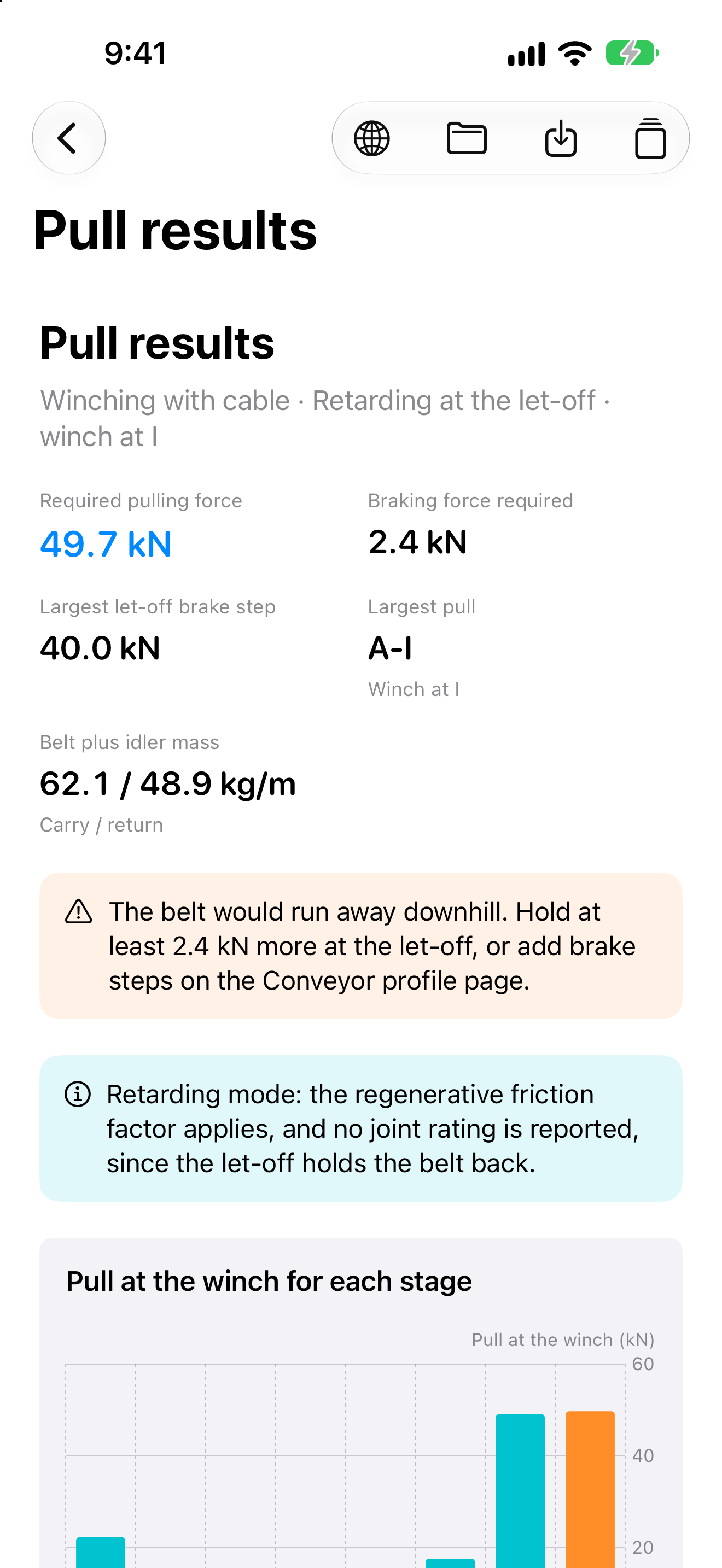
Plan the pull on iPhone, iPad, Mac or Apple Vision Pro. The iPhone layout brings pulling force, let-off braking and stage results together on a smaller screen.
Three questions before every belt pull
See the pull at the winch for every stage as the new belt advances, whether a winch cable draws it or the old belt is wound off ahead of it.
Read the rated tension the belt joint needs: the largest tension at the winder in any stage, including the cable’s weight on slopes.
On downhill conveyors, find out whether the belt would overrun the let-off and how much more braking it needs. Add brake steps as the belt advances and see their effect.
Computed example
The carry run falls about 116 m over 950 m, so the let-off must hold the new belt back while the winch at station I draws it down the carry side and up the return. Brake steps of 22.2 kN from the start and 40.0 kN from station C are entered.
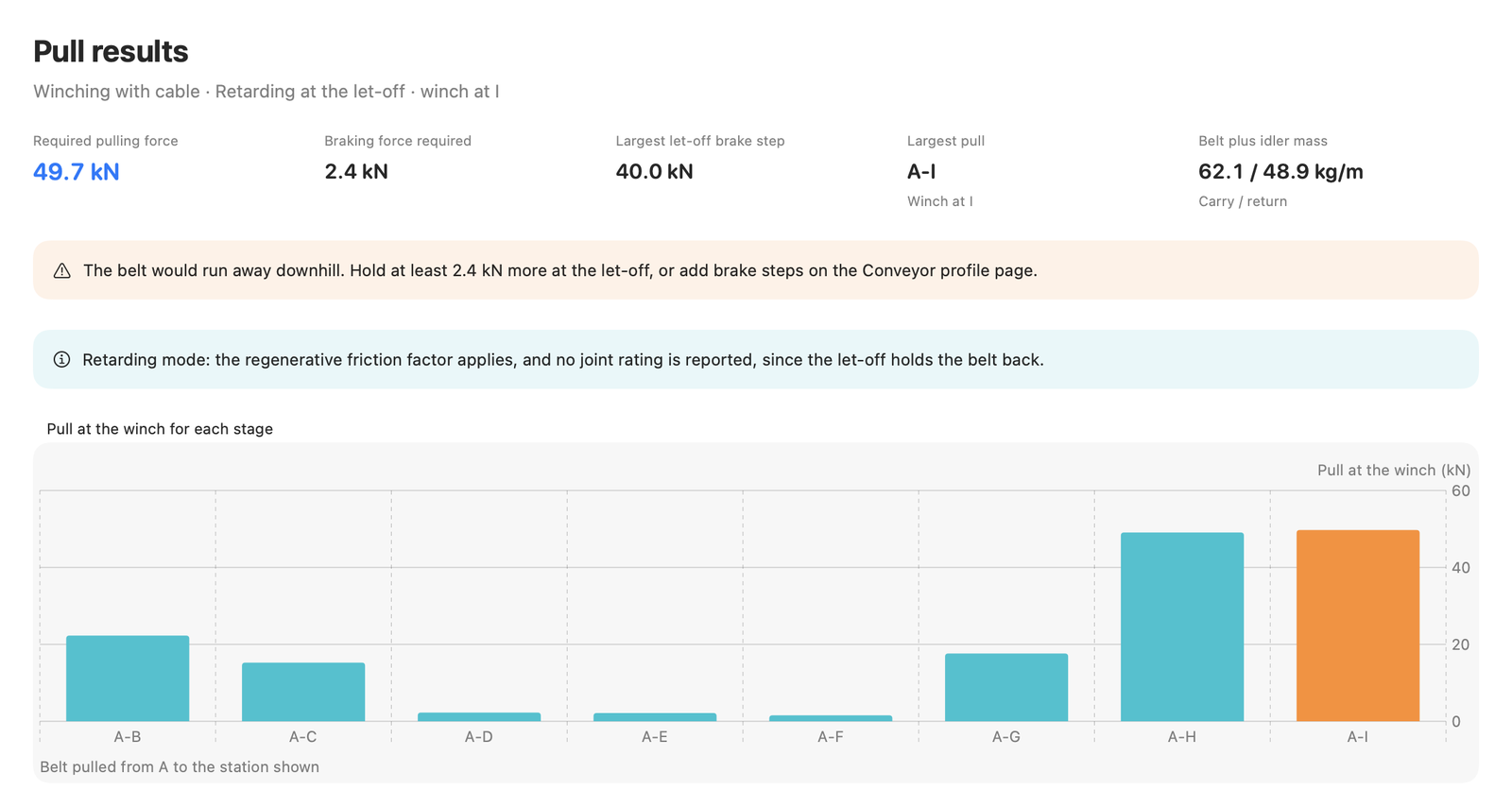
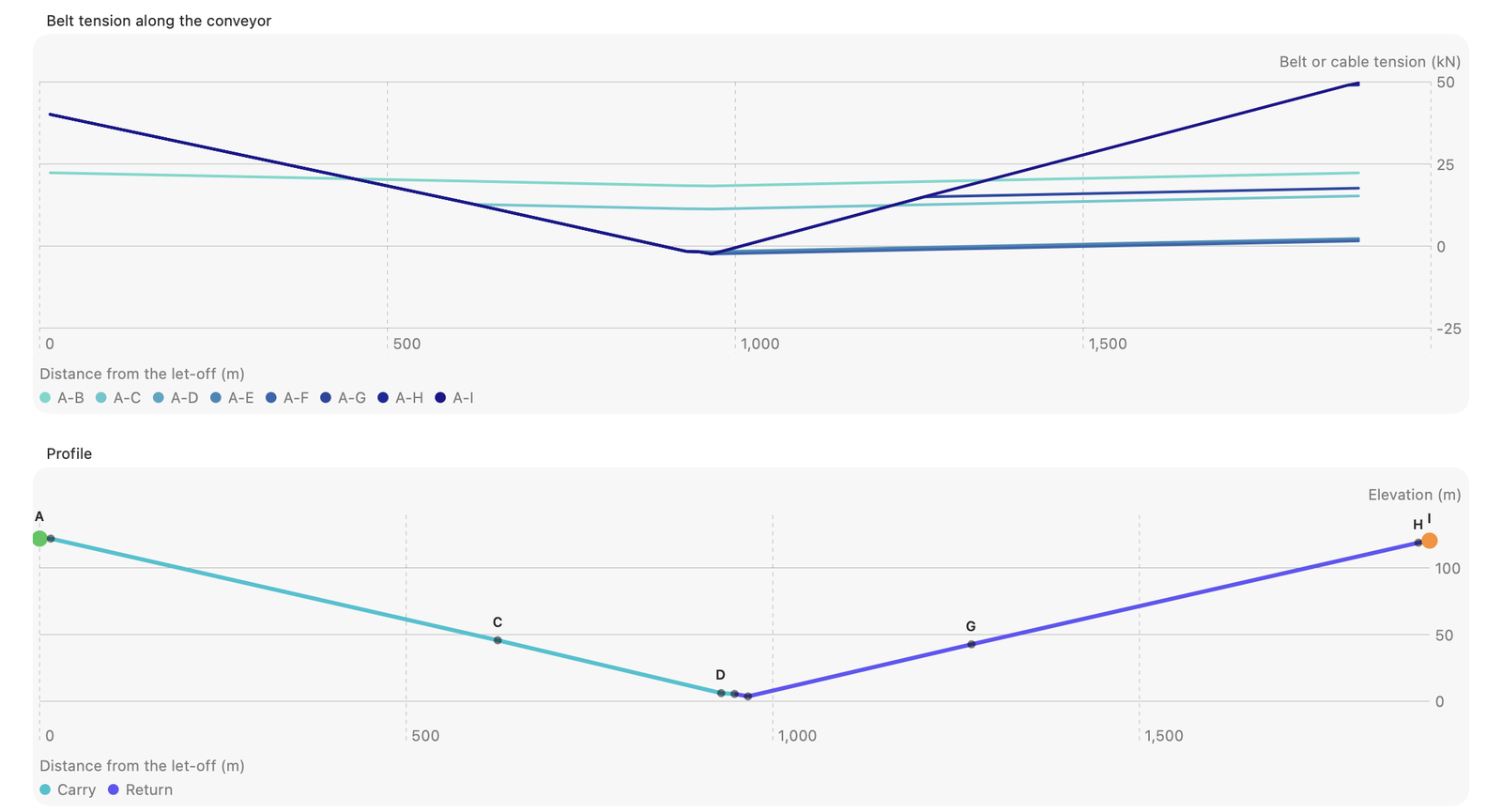
Belt 41.7 kg/m; winch cable 3.48 kg/m. Carry idlers: 24.9 kg rotating mass at 1.2 m pitch. Return idlers: 22.0 kg at 3.0 m. Retarding at the let-off with a regenerative friction factor of 0.010. Eight sections, from the let-off at A to the winch at I.
Each section adds the idler friction on the belt and idler rotating mass, and the belt’s weight over the section’s lift. The cable’s weight is carried between the belt head and the winch; cable friction is neglected. Forces are weights and resistances in newtons at standard gravity, 9.806 65 m/s². The imperial entries convert exactly, nothing is rounded along the way, and results are shown to 0.1 kN. Open this project from the app’s Examples menu.
Five workspaces
Choose winching with a cable or winding the old belt, and pulling at the winder or retarding at the let-off. Choose the belt, the CEMA idler class, flat or V returns and the idler spacing, and the winch rope. The app calculates the belt and idler masses and picks the smallest charted rope for the pull; override any of them with your supplier’s figures. Then set the friction factors and any additional resistance.
Add sections from the let-off on the carry or return side, as horizontal length and end elevation or as inclined length and angle. Place the winch at any station and add let-off brake steps.
See the required pulling force, the joint rated tension and any braking, with the pull at the winch for every stage and the tension at every station. Export the printout, CSV tables or a JSON report.
Trace the conveyor on Apple Maps, and drag its points with a mouse, Apple Pencil or finger, to place its stations and the pull-on and pull-off points. With your permission, show where you are and follow your position, or on iPhone and iPad your heading. Your location stays on your device.
Try belts against the fabric and steel cord mass charts, and look up the CEMA idler and wire rope charts. Copy a belt, idler mass or rope straight into the project.
Method & evidence
Each section adds the idler friction on the belt and idler rotating mass, and the belt’s weight over the section’s lift; beyond the belt head, the cable’s weight is carried to the winch. Automated tests check the calculation against hand calculations and eleven reference cases, including winding, let-off brakes, a winch at an intermediate station and metric input.
Every unit conversion is exact, and nothing is rounded before results are shown. The Method & evidence page in the app lists each step and the engineering assumptions to review.
Units & language
Projects store SI values: metres, kilograms and newtons, with results in kilonewtons or pounds-force. Show and enter them in metric or imperial units, converted exactly, with idler-spacing and belt-width presets for the USA, Brazil, South Africa, Germany and Australia.
Use the app and its text printout in 39 languages and regional variants, including Spanish, Portuguese, German, French, Chinese, Russian and Arabic.
Future updates · Optional beta program
We are looking for belt splicers, lead hands, supervisors, managers and engineers to test future Belt Installation Maven updates on real belt pulls. The public app is now available on the App Store.
We review every request. TestFlight invitations are sent to the Apple ID you enter.
We review every request and will contact you by email about the next steps.
Please check the form and try again, or email support@mavensoftware.ai.
One monthly subscription
Belt & method, Conveyor profile, Pull results, Site map and Belt & idler data, with their exports, on your supported Apple devices.
Start here, Method & evidence, and opening and saving projects stay available without a subscription. Subscribe with your Apple Account.
Belt Installation Maven Monthly
US$5 / month
First 14 days free for eligible new subscribers.
Automatically renews monthly after the trial unless canceled. Local App Store prices vary; Apple displays your price and eligibility before purchase. Cancel at least 24 hours before the trial ends to avoid a charge.
Available now on the App Store
Questions before you start?Winching the new belt with a cable, or winding the old belt off so that it draws the new belt behind it. Pull at the winder, or retard the belt at the let-off on downhill conveyors. The winch can stand at any station, and a conveyor can have as many sections as it needs.
While pulling, it is the largest tension at the winder in any stage, including the cable’s weight on slopes between the belt head and the winder. Where the cable runs downhill to the winder, check the tension at the belt head as well; the Method & evidence page explains this case. Retarding at the let-off reports braking instead of a joint rating.
Friction on the cable is neglected. Winding assumes the old and new belts have the same mass per length. Enter pulley and other fixed resistances as additional resistance. Results are planning figures: confirm them with the responsible engineer and against the ratings of the equipment you use.
Exactly. Projects store metres, kilograms and newtons. Imperial values convert with the international foot and pound, and pounds-force with standard gravity, and nothing is rounded before results are shown. Calculations that use rounded conversion factors can differ slightly.
Your project files remain yours. You can still open and save them, and read Start here and Method & evidence, after subscription access ends.
Use the same Apple Account and Restore Purchases on supported devices. The current public listing supports Mac and Apple Vision Pro. Move project files between devices through the file locations you choose.
Eligible new subscribers get 14 days of full subscription access. Apple determines eligibility and shows the offer before you subscribe.
Start with the belt, the idlers and the conveyor profile from the let-off to the winch.
Download on the App Store · Contact Maven SoftwareStart with the app’s available examples and review the engineering assumptions before applying results to your equipment.
Current public release: Mac and Apple Vision Pro. Subscription and eligible trial terms are shown by Apple.