
Direct answer
Start with the conveyor layout, alignment, loading conditions and a repeatable record of where the belt moves. A tripper and uneven loading make the application important. Choose a tracking device and its location using that evidence and the device manufacturer's application requirements, rather than applying a universal distance from a pulley.
How do you track a belt on a conveyor?
A useful diagnosis separates the structure and component geometry from the belt's repeating behavior and the effect of loading. Martin Engineering describes a systematic approach that starts with alignment and records the adjustments and their effects. Read its belt-training guide.
Collect a conveyor layout with travel direction, pulleys, take-up, tripper positions, loading points and the observed trouble location. Use the site's approved access and isolation procedures for inspection; this guide is a diagnosis-planning aid rather than instructions for adjusting moving equipment.
| Observation | Record | Question for the review |
|---|---|---|
| Belt passage | Movement over repeated complete revolutions | Does the pattern repeat with a section of belt or splice? |
| Loading | Loaded/unloaded condition and relevant loading changes | Does movement change with material distribution? |
| Tripper position | Position and configuration during the observation | Does the reported condition belong to one layout? |
| Location | Viewing point and direction of travel | Where was the movement measured? |
| Changes | Inspection findings and documented interventions | Can before/after observations be compared? |
What does a measured tracking profile show?
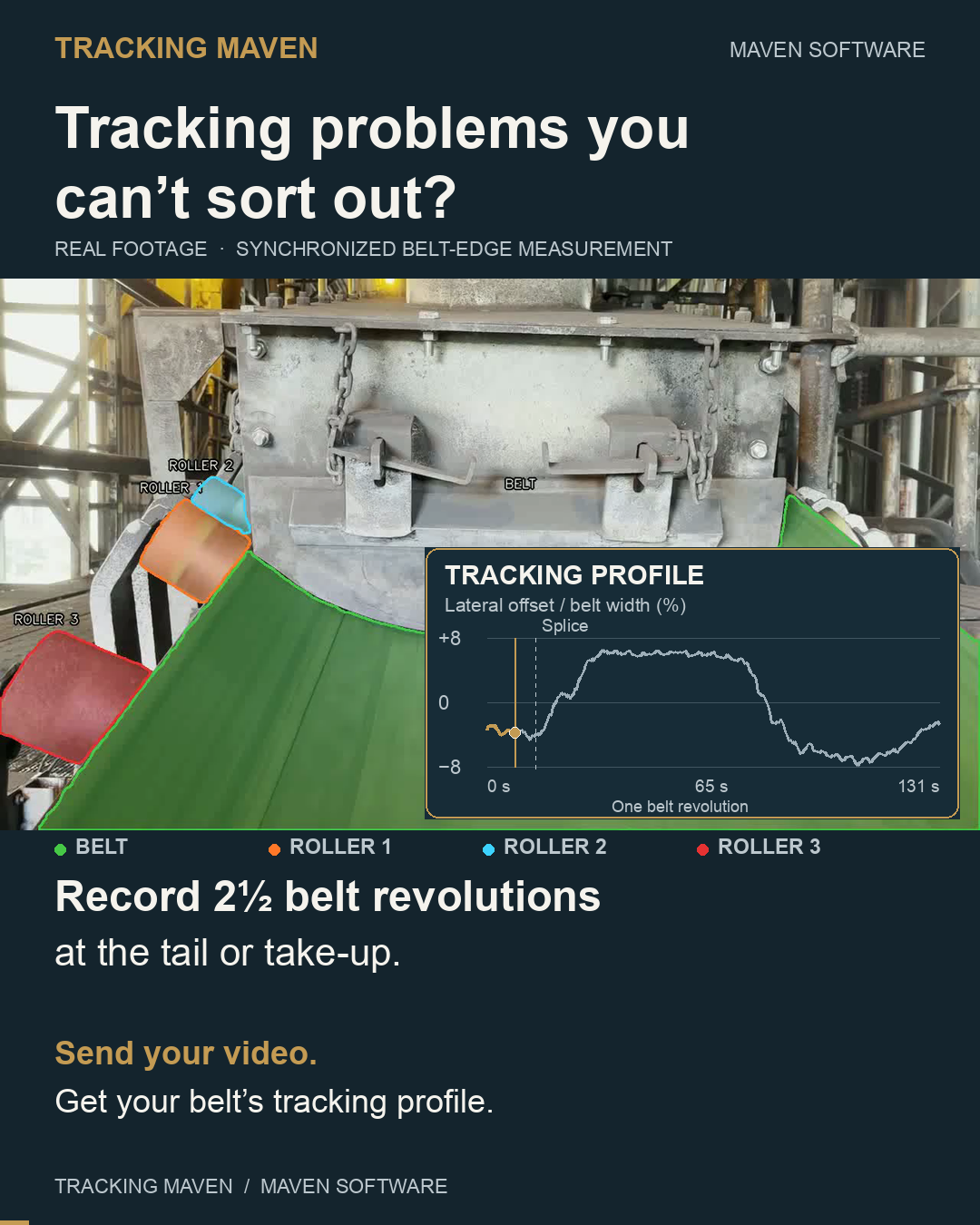
Tracking Maven turns suitable video into a belt-edge tracking profile. The published example synchronizes the observed lateral movement with the footage as the splice passes, and plots lateral offset relative to belt width. It is an image-derived observation using the footage and information available, not an automatic measurement in millimetres. The profile supports inspection and comparison; it does not calculate a complete mistracking-force model or approve a tracker location.
What should be recorded for a Tracking Maven review?
The current service guidance requests 2½ complete belt revolutions at the tail or take-up, filmed continuously from a safe, fixed viewing position. Keep the belt edge, rolls and fixed structure visible and send the original video with a conveyor identifier and problem description. Follow the full recording guidance.
Sources & scope
The external guide supplies alignment and systematic-recording context. Maven's actual example supplies the measured-profile scope. No universal tracker-placement distance or numerical force prediction is provided.
- Martin Engineering: How to train a conveyor belt
Primary guidance on alignment and recording changes. Apply appropriate site and equipment requirements.
- Tracking Maven video, profile and recording instructions
Actual service example and current video requirements.
This AI-assisted guide combines linked primary references, Maven product descriptions and original planning examples. Examples are labelled; equipment-specific decisions require the applicable approved specification.